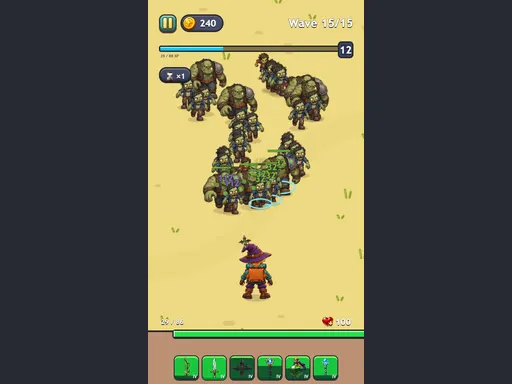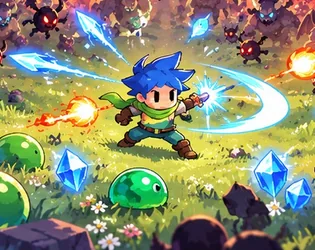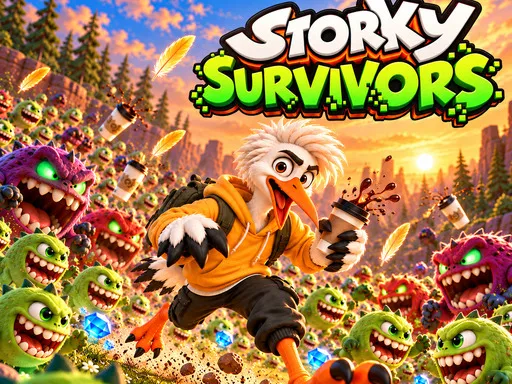
Storky Survivors is a cute 3D survivors-style roguelike you play free in a browser tab. You guide Rookie Storky across open ground while the weapons you carry fire without a click. Glitchlings press in from the edges, gems fill a level bar, and each level freezes the field so you can pick an upgrade that changes how that auto-fire kit behaves. The run ends when your health empties, or when a stage boss decides the attempt.
Auto-fire, gems and the short loop
The first seconds set the contract. You spawn with movement on WASD or the arrow keys and at least one weapon that already works. There is no aim key and no attack button on the desktop layout the listing describes. Shots leave on a timer of their own, so the only continuous decision is where to stand and when to cut through a gap in the crowd.
Fallen enemies leave the usual survivors currency of experience gems. Walking over them fills the bar. When the bar completes, the game pauses and offers upgrade choices. That pause is the whole build system: you assemble a kit while the clock is already running rather than crafting between runs in a quiet shop.
Because the weapons fire alone, crowding is the real threat. Standing still to “aim” does nothing useful. Circling the densest pack, peeling off stragglers, and leaving a lane behind you are the habits that keep auto-fire useful instead of wasted into empty air. On a phone, the same idea maps to an on-screen joystick: drag to move, tap when a level-up hand appears.
Sessions are built for browser tabs. A single stage can finish quickly if you die early, and the listing also points to an endless mode once you want a longer hold. That length suits a break between other tasks, and it also means a bad upgrade line does not waste an evening. You die, you restart, and the next kit can look nothing like the last one.
Stages, bosses and endless pressure
The GameMonetize blurb frames a campaign of ten stages plus endless play. Treat that as a ladder of density rather than a story with cutscenes. Early stages teach the auto-fire spacing. Later stages pack more Glitchlings into the same movement vocabulary and drop larger bosses into the middle of the field.
A boss is less a new control scheme and more a louder version of the same problem: keep Storky alive while the weapons do the damage. If your upgrade line never expanded coverage, the boss arena will show it quickly. Pierce-style and area picks reward walking through columns; single-target spikes reward focusing the named threat while the swarm still nips the edges.
Endless mode is the same loop without a stage exit. The value is reading how long a build lasts once the spawn rate stops being polite. Players who like score-attack habits will recognize the pull; players who only want a finite clear can stay on the numbered stages.
Upgrade picks that rewrite the kit
Level-ups are where one run separates from another. The listing does not publish a full card encyclopedia on the feed page, so this entry does not invent named percentages. What it does document is the shape: weapons and upgrades stack while auto-fire stays the only attack verb. Early picks that cover a blind angle matter more than greedy damage if bats of Glitchlings (or whatever the stage is throwing) arrive from behind.
A forward-heavy line wants something that cleans a lane so the first monsters in a column do not eat every shot. A swarm-heavy line wants wider coverage so the ring that forms when you cut too tight a loop does not close. Mobility-adjacent upgrades buy a second of breath when a boss telegraph fills the screen. Crit or burst styles reward focusing elites instead of spraying the edges forever.
None of these choices ask you to change the control scheme. WASD stays WASD. What changes is the shape of the damage cone and how forgiving a mistake feels. That is the survivors promise in a compact, cute 3D wrapper: one move verb, many build verbs.
Controls and focus
Movement is WASD or the arrow keys on desktop. Attack is automatic. Level-up upgrades take a mouse click or a tap. Touch devices use the on-screen joystick for movement. Click the game frame once so the browser passes keys into the embed. If WASD seems dead, focus is usually the cause rather than a broken build.
After a level-up choice, movement resumes the moment the pause clears, so be ready to leave the spot where you were standing when the bar filled. There is no separate dash key documented in the feed instructions for this title, so spacing has to come from pathing and from whatever mobility the upgrade hand offers.
A desktop keyboard-and-mouse session matches what this page describes first. Touch can work for movement and taps, but a laptop or desktop browser is the safer seat if you want the full WASD feel.
Where it sits next to other survivors
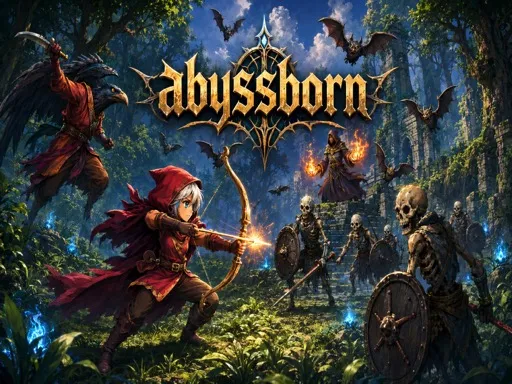
Anyone coming from Abyssborn will know the shape immediately: one hero, auto weapons, gems, cards, a clock that only moves forward. Storky Survivors keeps that loop but leans on a cute 3D stork fantasy and a stage-plus-endless structure instead of a single abyssal archery field. The fantasy here is Glitchling swarms and stage bosses rather than tengu and skeleton packs.
Dreamland Survivors sits on the pixel-fantasy end of the same family, with reroll, banish and a land-to-land portal chain. Storky is the lighter, cuter cousin for players who want auto-fire and upgrades without memorizing a wide secondary-control sheet. Nebula Marshal, also on this catalog, swaps the stork fantasy for a space-western arena with WANTED bosses; both still ask you to move while guns fire alone.
If you want seven class trees and inventory screens, look toward heavier action-RPG survivors on the shelf. If you want a browser-friendly auto-fire run with a cheerful mascot and stage bosses, stay here.
Why another attempt still feels fresh
The draw is not a new control scheme. The draw is how differently the same stork plays once weapons and upgrades stack in a new order. One run clears lanes with wide coverage and melts bosses with focused spikes. The next run lives on a different early pick and dies the moment the ring closes. Both start with the same WASD walk and the same silent attack button.
Because attempts can end quickly, the cost of a dead-end upgrade line is low. You learn which early picks cover side spawns, which ones leave you helpless when a boss lands, and which stage layouts punish a forward-only kit. That learning sits in your hands rather than in a permanent meta tree this page can quote with invented numbers.
StorkyVerse is credited on the GameMonetize catalog page; that host also serves the embed used here. Cover art credit follows the listing. Play in the frame above when you want a compact, cute survivors session that stays about movement, auto-fire and the next upgrade card.