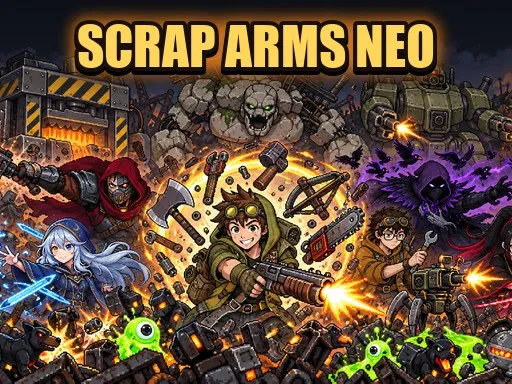
SCRAP ARMS NEO is a pixel-art top-down roguelite you play free in a browser tab. You walk a scrap-strewn field while every weapon in your stack attacks on its own. Monsters press in, level-ups pause the run for upgrade picks, and weapons wear out until they break and explode. The fantasy is less a permanent legendary loadout and more a living belt of tools you keep replacing under pressure.
Auto-attack with a breakable stack
The survivors contract is intact: movement is the continuous verb, and attack happens without a fire button. The twist is durability. Each pickup joins the stack and contributes automatic damage until it fails. When a crowbar or gun breaks, the explosion is both a farewell and a reminder to scavenge the next piece before the ring closes.
That durability loop changes how you read the field. In a pure Vampire Survivors cousin, a weapon you take at minute two is often still there at minute ten. Here, the stack is a temporary machine. You still want coverage in every direction, but you also want a plan for the moment a key piece detonates and leaves a hole in the cone.
Movement uses WASD, arrow keys, or left click on desktop, and drag on touch. Switching weapons with the mouse wheel or a slot tap lets you favor what still has life. Dropping with X, right click, or an upward slot drag clears junk you would rather replace. Space triggers Full Burst or the character skill when the bottom of the screen is the wrong place to stay polite.
Stages, characters and the Back side
The listing frames six playable characters with unique skills, nine stages with bosses, and a harder Back side for players who clear the front route. Treat that as a ladder of density and scrap themes rather than a novel with cutscenes. Early stages teach you to keep the stack fed. Later stages and the Back side punish empty belts and greedy drops.
Bosses are denser versions of the same problem: keep moving while the auto-attack layer deletes the arena. If your stack is a single forward gun with no side coverage, a boss plus trash wave will show it. Full Burst is the panic valve for those moments, not a replacement for a healthy weapon belt.
Between stages, the meta hook is bringing surviving weapons home and spending score on a weapon gacha. This page does not invent drop rates or coin prices. It only notes that a good run can feed the next attempt’s starting options, which is why dying with an empty belt feels worse than dying with scraps still in hand.
Level-up upgrades and build reading
Every level-up still asks for a card choice. The feed does not publish a full upgrade encyclopedia, so this entry will not invent percentages. What matters is the reading skill: does the offered upgrade cover the angle your breaking weapons are about to abandon, or does it double down on a lane you already own?
A swarm-heavy stage wants area and multi-hit styles so the automatic layer can clear the ring that forms when you cut too tight a loop. A boss-heavy stage wants burst and focus so Full Burst and the strongest remaining gun can delete the named threat. Mobility and defense picks buy the seconds you need to walk to the next scrap pile after a break explosion.
Characters matter because their skills change how often you can ignore a bad stack for a moment. One skill might be a escape tool; another might be a damage spike. The listing names six characters without spelling every kit on the feed page, so learn them in play rather than from invented patch notes here.
Controls and focus
Desktop: move with WASD, arrows, or left click; switch with the wheel; drop with X or right click; Full Burst with Space; pause with P. Touch: drag to move, tap slots to switch, drag a slot up to drop, and use the bottom-right control for the skill. Click the game frame once so keys reach the embed.
After a level-up, the field resumes immediately. Be ready to move before a breaking weapon’s explosion is the only thing still dealing damage near your feet. Portrait and landscape are both documented, which makes this one of the friendlier survivors-adjacent embeds for a phone, even though a keyboard still feels precise for wheel-swapping.
Where it sits next to other survivors
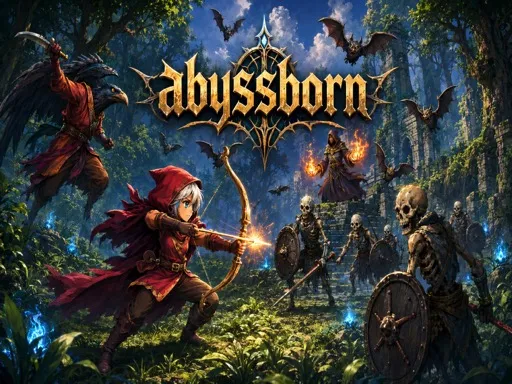
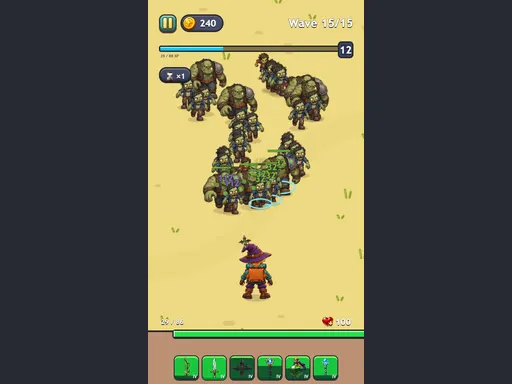
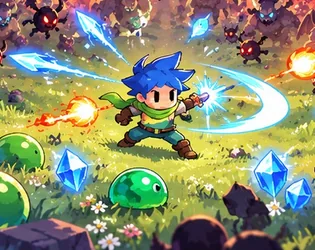
Abyssborn mutates a single bow through skill picks. SCRAP ARMS NEO mutates a whole breakable belt. Dreamland Survivors keeps permanent-feeling weapons inside a run and adds reroll and banish; here the drama is watching a legendary gun cook itself to death while you scramble for a crowbar. D2 Survivors sits on the heavier class-and-loot end of the shelf; Scrap Arms is lighter, pixel, and inventory-as-stack rather than inventory-as-menu.
If you want archery in an abyss, open Abyssborn. If you want pixel scrap yards where auto-attack tools expire on purpose, stay here. The near-neighbor promise is the same: one move verb, many build verbs, a clock that only moves forward.
Why another attempt still feels fresh
The draw is the tension between auto-fire comfort and breakable scarcity. One run rides a stacked belt into a clean boss clear and banks survivors for the gacha. The next run watches two guns explode in the same breath and dies in the hole they leave. Both start with the same WASD walk and the same rule that weapons attack alone.
Because stages are discrete and deaths are cheap in browser time, you learn which early upgrades forgive a break, which characters’ skills cover a empty stack, and which bosses punish a forward-only belt. That learning sits in your hands rather than in absolute play counts this catalog refuses to invent.
CK GAME is credited on the GameMonetize catalog page; that host also serves the embed used here. Cover art credit follows the listing. Play in the frame above when you want a pixel survivors-roguelite about movement, breakable auto-weapons and the next upgrade card.