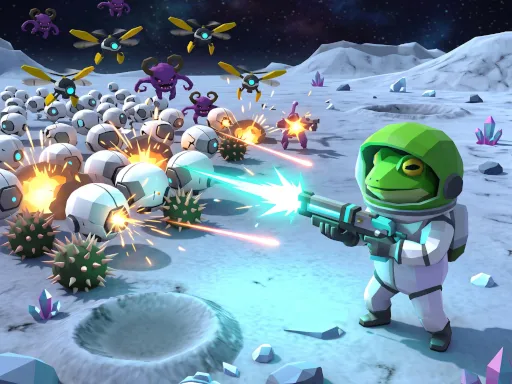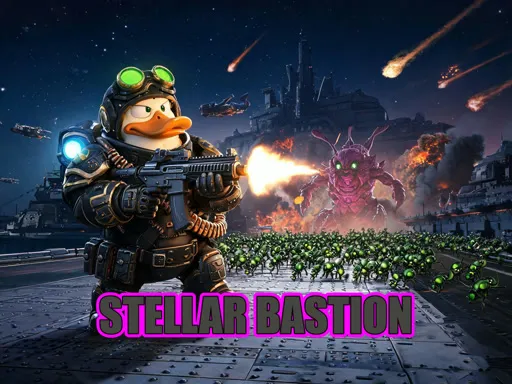
Stellar Bastion is an endless wave-survival shooter you play free in a browser tab. You are the last gunner on a star-fortress flight deck while insectoid bugs pour in with one goal. The rifle finds the nearest target on its own. Your job is where to stand, when to roll, which limited-ammo gun to burn, and which perk cards to keep as the wave clock ticks. The run ends when you die or when you hit END to bank what you have earned.
Auto-fire on the flight deck
The first seconds set the contract. Hold the mouse or a finger and you walk toward that point while the gun already fires. On a keyboard you can steer with WASD or the arrows instead. There is no separate aim stick on the core loop the listing describes. Nearest-bug targeting means a crowded pocket pulls your shots whether you wanted that pocket or not, so the useful habit is to keep a lane of clear ground and let the auto-fire eat the front of the pack.
Waves do not wait for you to feel ready. Escalation lands on a short interval, and every fifth wave a HIVE KING accelerates the swarm. That beat is the survivors clock in space-fortress clothing: density rises on a schedule, not because you opened a door. Standing still to “line up” a shot wastes the only resource that matters, which is space on the deck.
The MK-1 sidearm is the safety net. Heavier guns drop with limited magazines. A rocket that clears a knot of bugs is worth the reload risk only if you still have a path out when the magazine clicks empty. Switching with 1-4 is how you choose the shape of the next few seconds without ever taking your hands off movement for a long aim ritual.
Perk cards without a quiet shop
Level-ups in Stellar Bastion lean on three-pick-one perk cards drawn from a wide upgrade pool. The listing stresses that those choices arrive without pausing the fight the way a classic survivors hand freezes the field. That changes the risk. You are reading cards while bugs still close, so a slow decision is itself a positioning mistake.
Treat each card as a rewrite of how the auto-fire feels rather than a new control scheme. Some lines want more ammo economy so the special guns stay online. Others want movement tools so the Shift roll is not your only breath. Others thicken damage so the nearest-target rule hurts less when the wrong bug is closest. You will not see every card every run, and the order you take them still matters when the HIVE KING speeds the timer.
Because the fight does not fully stop, the habit of clearing a pocket before you open the hand matters more than in pause-heavy titles. If the ring is already closed, the “best” damage card on paper can still lose to a card that buys space. That is the survivors promise under a stricter clock.
Guns, rolls and banking the score
Combat roll on Shift is the panic verb. It is not a second weapon. It is how you leave the tile the swarm decided to occupy while the rifle keeps working. Pair rolls with gun switches: dump a shotgun into a dense cone, roll out, fall back to the sidearm, and only then chase another pickup. Ammo-limited weapons punish greed more than skill issue storytelling does.
On-screen controls also expose pause, an END button to bank score, a mission brief and music toggles. END is the honest alternate ending for a browser session. If the next HIVE KING is about to land and your perk line is a mess, banking beats a voided attempt that teaches nothing new. Auto-pause when the tab is hidden is listed as well, which suits a game meant to live beside other tabs.
A desktop keyboard-and-mouse seat matches the fullest control list. Touch hold-to-move covers the same auto-fire fantasy on a phone, but gun hotkeys and the roll key are cleaner with a keyboard under your hands.
Where it sits next to other survivors
Anyone coming from Nebula Marshal will recognize guns that fire without a click and crystals or kills that feed a build. Stellar Bastion keeps that auto-fire promise but locks the fantasy to a single flight deck and a wave timer with named Hive King spikes. There is less “evolve a whole arsenal across open space” and more “hold this rectangle while the calendar of waves gets rude.”
SCRAP ARMS NEO sits nearby as another top-down auto-attack roguelite, usually with a wider weapon-identity fantasy. Stellar Bastion is narrower and louder about positioning: nearest-target lock means bad footing is punished immediately. Abyssborn is the archery cousin in the same catalog family—movement first, attack automatic, short attempts—except Abyssborn pauses harder for skill picks while Stellar Bastion keeps the swarm alive under the card hand.
Orb Rush is not a survivors game, but it shares the browser habit of short attempts and rising pressure. The difference is dodge-for-orbs versus route-the-horde while damage fires itself. Both reward clean movement more than button complexity.
Why another wave still feels fresh
The draw is not a new control scheme. The draw is how differently the same deck plays once perk order, ammo guns and roll timing stack into a new answer for the same nearest-bug rifle. One run lives on sidearm discipline and never wastes rockets. The next run dumps magazines into Hive King windows and banks early when the perk line fails.
Because waves escalate on a fixed rhythm, you learn the calendar in your hands. You learn which early cards cover the speed-up beat, which gun drops are traps when you are already cornered, and when END is the skilled choice instead of pride. MrHorfen is credited on the GameMonetize catalog page; that host also serves the embed used here. Cover art credit follows the listing. Play in the frame above when you want a compact auto-fire wave session that stays about positioning on a star-fortress deck.