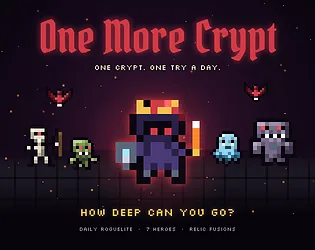
One More Crypt is a turn-based crawl through a fantasy crypt where every step you take is also a step for everything else. Enemies only act when you act, so a fight is a problem of positioning before it is a problem of damage. Notjstn made it, and it plays in a browser on itch.io with no sign-up.
One move at a time
Movement is turn-based, and the crypt answers each move. Bump into an enemy and you attack it. Step anywhere else and the enemies near you get their turn. Space waits, which is a real option when you want a foe to come to you instead of walking into it.
Controls are split by device. On desktop you use the arrow keys or WASD, with Space for waiting. On mobile you swipe or use the on-screen pad. No other buttons are listed, so the whole game runs on movement and the choice of when to stand still.
Attacking is a matter of walking into a foe, so a fight and a step are the same action. There is no separate attack button, and no range to check beyond the space you are moving into. That keeps the vocabulary small and puts the weight on which direction you choose.
Relics and the Soul Forge
Clearing a floor opens the stairs, and each descent gives you a choice: take a relic or rest to heal. That single decision repeats all run, and it is where most of the tension lives. Health now or power later is the question the game keeps asking.
There are 41 relics, and they stack. Eighteen hidden combinations are in the game for players who experiment. The Soul Forge fuses relics into stronger forms, which adds a second layer on top of simply collecting them. Souls are the wider unlock currency, opening heroes and forbidden relics. The forge is the piece that turns a collection into a plan.
Relic choice is the main build decision, and stacking is what makes it worth thinking about. A modest relic can matter more if it completes a combination, and the eighteen hidden pairings are the reason to keep trying new sets rather than repeat a favourite.
Daily runs, endless mode and bosses
The daily descent hands everyone the same crypt and the same hero for one attempt. You get one try, then you can see how deep you got against other players on the daily leaderboard. A daily run takes a couple of minutes, which makes it a small commitment rather than a session.
The leaderboard compares depth, which is a simple measure and an easy one to read. It also means the daily is a score attack rather than a story: the crypt and hero are fixed, so the difference between players is the decisions they make.
Endless mode is the longer option. It includes seven heroes with different playstyles, so the mode is not just the daily without a limit. If the shared attempt is the test, endless is where you take your time and try the heroes out.
Descent is measured in floors, and a boss waits every five of them. Three are named: the Bone Warden, the Plague Abbot and the Lich King. That rhythm gives a run a repeating shape, with four ordinary floors between each check. A five-floor gap is long enough that the boss arrives as a change of pace rather than a constant threat.
The crypt is fantasy, and the game carries both roguelike and roguelite labels. The distinction shows in how it plays: a run is a run, but Souls and unlocked heroes carry across attempts. It is listed as released and is not called a demo.
Who it suits
One More Crypt fits players who like to think a move ahead. The daily gives a fixed puzzle and a leaderboard, while endless gives room to experiment with relics and heroes. The known limit is pace: this is not an action game, and nothing happens until you press a key. Players who want a fast loop should look elsewhere.