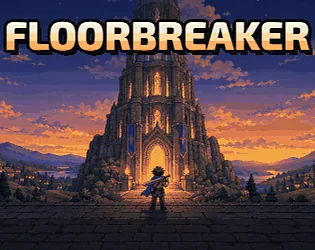
Floorbreaker builds a run around a simple question: which door next? You climb a fantasy spire room by room, and each cleared fight ends with a choice of paths toward the boss waiting above. Makungggg made the game as a top-down pixel-art action roguelite, and it plays in a browser on itch.io with no download.
The premise is a game inside a game. You are placed inside a spire with a way out somewhere above you, and the only route is upward. Rooms connect to rooms, and the boss at the top of each stretch is the thing you are climbing toward.
One life, one character
The game enforces a single life. When your character dies, that character is deleted, so a run only continues while you keep it alive. It is a released game rather than a demo, and the whole climb is meant to fit in one sitting. A save does exist, which means you can close the tab and pick up later, but the death rule stands. That rule shapes how you spend resources, since a potion is worth more when the alternative is losing the character entirely.
Combat is close and quick. You move with WASD or the arrow keys and aim with the mouse. J or a left click swings your slash, while K, L and I fire Blade Arts. A roll sits on Space, and it earns its place because bosses telegraph their attacks. Reading a fight and timing that roll is the difference between progress and a deleted save. Potions are mapped to Q, and E handles both talking and shopping.
Room by room
Clearing a room opens a set of doors, and each one carries a different reward. Gold and experience are the plain options. Potions help you stay alive. Shops let you spend, and shrines trade a price for power, so the door you take shapes what the rest of the climb looks like. Level-ups add upgrades on top of that.
Elite rooms are where a build starts to take shape. They hand out Blade Arts, which you equip with elemental mods and then evolve. Fire, lightning, thorn and tide are the mod types the game lists. Memory Shards collected on a run unlock more Blade Arts for later attempts, so a failed climb still leaves you with something.
The spire
The climb is split across four towns, and a boss guards each one. That gives the run a visible shape: you always know roughly how far you have come and what stands between you and the next stretch. Boss fights are the places where the timing work matters most, since their attacks are announced before they land.
Comfort options are listed as well. Keys can be remapped, a gamepad is supported, and an assist mode is available. Screen shake, flashing and tips can each be switched off. Pause sits on Esc or P, F toggles fullscreen, and M mutes the game. Floorbreaker is free, and the creator notes that AI helped with the graphics, which were then cleaned up and reduced to a hand-picked palette.
Who it suits
The pitch is narrow on purpose. It wants players who like fantasy RPG trappings, short runs and decisions made between fights. It is not a long campaign, and the single life is a real limit. Anyone who prefers forgiving progression should know that before starting. The compensation is that a run is short enough to restart without much lost time, and Memory Shards soften each failure.
The build layer is where most of the replay sits. A run’s identity comes from which Blade Arts you find, which mods you slot into them, and how far you push the evolutions. Because Elite rooms gate those drops and doors decide whether you reach an Elite room at all, the route and the build are the same decision seen twice. That is the tension the game trades on, and it is enough to give a short climb branches.