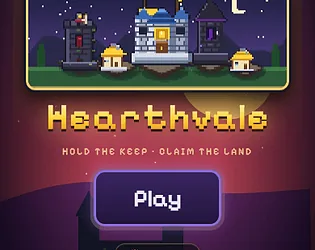
Hearthvale is a city builder and tower defense game with cards at the center of both halves. You raise a settlement by day and defend it when monsters arrive at night. Runs are endless, so there is no final victory to chase. Levi7hart made it, and it is singleplayer, free on itch.io, and built for desktop and phone play.
Day for building, night for holding
The loop splits into two moods. In daylight you spend cards on farms, forges, towers, crops, and other districts. At night the monsters come, and what you built either holds or does not. The switch gives each run a rhythm: expand, then survive, then expand again.
Fog hides parts of the map, and you buy those areas back over time. That pacing matters because your build space is limited at the start. You choose where each building goes, which districts sit next to each other, and where rally points and walls should stand.
Cards, districts, and fog
Cards are how you build. Each draw limits what you can build in that moment. You play what you hold rather than picking from a full menu. Because you draw rather than choose freely, an early hand can set the tone for a whole district. Neighboring buildings can gain buffs when they sit together, so placement is never purely cosmetic.
Crops produce random loot, which is a small gamble each time you plant them. You can put captured monsters to work on a farm or send them into idle dungeons. That means the things that attack you at night can become part of the economy later. Three gunas sit alongside loot tiers as run-level choices, though the listing does not spell out what each one does.
A node map adds a layer above the settlement, and the game also includes hidden quests and named elites. Those are the reasons a second run does not look like the first even when you start with the same cards.
Towers, walls, and waves
Defense is the half that decides whether the run continues. Towers are hybrids with three upgrade paths, so the same tower can end up doing different jobs depending on what you invest. A single tower can cover more than one job. Walls are described as Tetris-like, so fitting them together is part of the plan. Rally points give you a say in where your side gathers when a wave arrives.
Night pressure is the test. Monsters arrive in waves, and bosses appear among them. The day-night cycle means you never get a long stretch of quiet building. The listing lists lives as one of the run’s resources, so a leak at night has a cost that follows you.
Because runs are endless, the wave design has to carry a lot of the long-term interest. Ascension tiers and bosses give the later nights something to scale against. The settlement you built early is what you defend later.
A run that never wraps up
There is no final victory condition. The listing calls the structure infinite, and progression continues into the next age rather than ending on a credits screen. That is the finished shape of the game, not a placeholder. The listing gives no run length, since there is no endpoint to measure. You stop because you choose to, not because the game concludes.
The long-term layer is where the replay lives. A 193-node tech web and permanent research sit outside any single run. Ascension tiers give you a reason to start again with a harder target. Between runs you are not just repeating the same opening.
It is singleplayer, free, and playable in a browser, with support for desktop and phone devices. The listing discloses AI assistance, and Levi7hart is the credited creator. A campaign with a defined ending is not what this is. A settlement to keep rebuilding is.