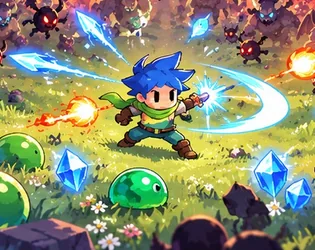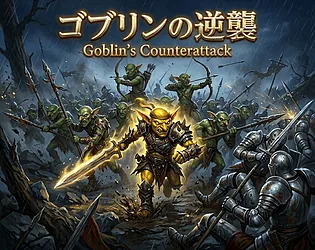
Goblin Rush flips the usual arrangement. You do not defend one hero against a swarm; you are the swarm, and the heroes are the ones who have to survive. Cuprum Legion built it alone, as a prototype, and it runs in a browser on itch.io. One full run takes about six minutes.
One goblin, many bodies
The goblin you steer carries a sword, a spear or a bow. Around it, hundreds of other goblins move and attack on their own, so your job is direction rather than total control. You pick where the pressure goes and which hero it lands on. The rest of the horde fills in the space you leave.
That control is touch-based. You drag to move and tap to attack, and a button in the top right corner pauses the game. Because the horde handles itself, the input load stays light, and the game is built for a phone as much as a desktop.
Your goblin’s weapon is the main thing you carry into a fight. A sword, a spear and a bow are the three options the listing lists, with no ranking between them. Which one you take decides your reach and how much risk you accept when the horde pushes forward. The horde fights alongside you either way, so the weapon is a modifier on the swarm rather than a separate class.
Ten heroes, six minutes
Each run is a march through stages toward ten heroes, and two of those fights are party encounters. The heroes grow stronger as the run goes on, which puts a clock on your aggression. A full run is designed to take about six minutes, so the whole arc is short enough to retry immediately.
Losing goblins is not free. Every goblin that dies gives the opposing hero experience, so a careless push hands the enemy the strength it needs to survive. Numbers still matter, but they have to be spent with some thought.
Upgrades, orbs and ranks
Each stage ends with a pick from three goblin upgrades. A clear at S rank adds a bonus pick, so a strong performance compounds. Clear ranks are judged on time and on how many goblins you lost, which means the score measures both speed and care at once. The listing refers to ranks from S down to C, so there is room to improve without a perfect clear.
Healing orbs sit in the same space as everything else. Heroes chase them, and using that pull is part of the game. If a hero commits to an orb, the fight moves to wherever the orb is, and you can plan around that.
What the prototype aims for
Goblin Rush is honest about its size. It is a short, solo-made prototype rather than a long campaign, and nothing here pretends otherwise. What it offers is a compact loop: pick a weapon, push through stages, take upgrades, and try for a better rank next time.
The flipped premise is the reason to play it. Most games in this space ask you to keep one character alive while enemies pour in. Here the enemies are yours, and the thing you are trying to kill is learning from every one you lose. That inversion changes how a fight feels, and it gives the short run a shape of its own.
The game suits short sessions. Six minutes is the stated length of a full run, and the rank at the end gives you a reason to go again. Players who know the horde genre will recognise the upgrade picks, though the roles are flipped here. Score chasers get the S rank to aim at.
It is a prototype, and nothing is described beyond the ten heroes, the stages and the upgrade picks. That is the whole offer: a small, repeatable fight with a rank attached. Try it if the inverse setup sounds interesting. Skip it if you want a campaign with length behind it.